- Next.js 15
- React 19
- TypeScript
- Tailwind CSS v4
- Velite
- MDX
- Motion
- shadcn/ui
- schema-dts
- Edge Runtime
Personal Portfolio Site
A meta-engineered portfolio where one edit propagates everywhere
My personal portfolio designed as a single-source-of-truth system. Every piece of content lives as typed MDX or config, and a single edit propagates automatically through the front-facing UI, page metadata, sitemap, JSON-LD structured data, dynamic Open Graph images, and breadcrumbs. The whole site runs on a planned content and metadata graph instead of hand-synced copies.

Live: shakeefahmedrakin.vercel.app Code: GitHub
Overview
This portfolio is intentionally over-designed. Not in the visual sense, but in the architectural sense: it is a meta-engineering exercise where the goal was to build a content and metadata graph so tightly wired that the site is effectively zero-maintenance once the system is in place. Every project, achievement, paper, work entry, and bio fact is the input to a planned pipeline that fans out into the UI, SEO surface, structured data, and OG layer with no hand syncing in between.
A Single Source of Truth, Everywhere
The defining property of this codebase is propagation. There is exactly one place to change any given fact, and that change shows up in every layer of the site automatically:
- Update a tagline in
content/site-config.tsand the home hero, footer, page titles, meta descriptions, JSON-LDPerson,Website, andOrganizationschemas all reflect it on the next build. - Add a new project as an MDX file under
content/projects/{category}/{slug}/index.mdxand the projects listing, the dynamic[slug]route, the sitemap, the breadcrumb trail, the JSON-LDTechArticleschema, and the page level Open Graph image are all generated for it without any other edit. - Bump a work entry's end date in its frontmatter and the about page timeline, the home experience section, the
Person.worksForschema, and theknowsAboutkeyword set update from the same input. - Toggle
isFeaturedon a project and the home grid, the OG-driven sharing card, and the schema all react to it.
There are no duplicate copies of project titles, no static OG dumps committed to the repo, no manually edited sitemaps, no hand-rolled JSON-LD blocks. The system was designed to make those things impossible to drift.
Type-Safe Content Pipeline
Content lives as MDX in content/, processed by Velite into schema-validated typed collections that the App Router imports directly:
- Projects under
content/projects/{category}/{slug}/index.mdx - Achievements under
content/achievements/{slug}/index.mdx - Research under
content/research/{slug}/index.mdx - Work Experiences under
content/workExperience/{slug}/index.mdx
Frontmatter is validated against a typed schema, MDX is compiled at build time, images automatically get blur data URLs, and consumers get fully typed imports. No runtime CMS, no fetch on render, no headless CMS overhead. Adding content is a typed file write, not a content management workflow.
SEO and Structured Data Graph
The metadata layer is the most engineered part of the site. JSON-LD is composed from shared primitives (Person, Organization, Website, BreadcrumbList, ImageObject) and assembled per page type into a connected graph using @id references, so every page contributes nodes that link back into a coherent entity model rather than living as isolated blobs.
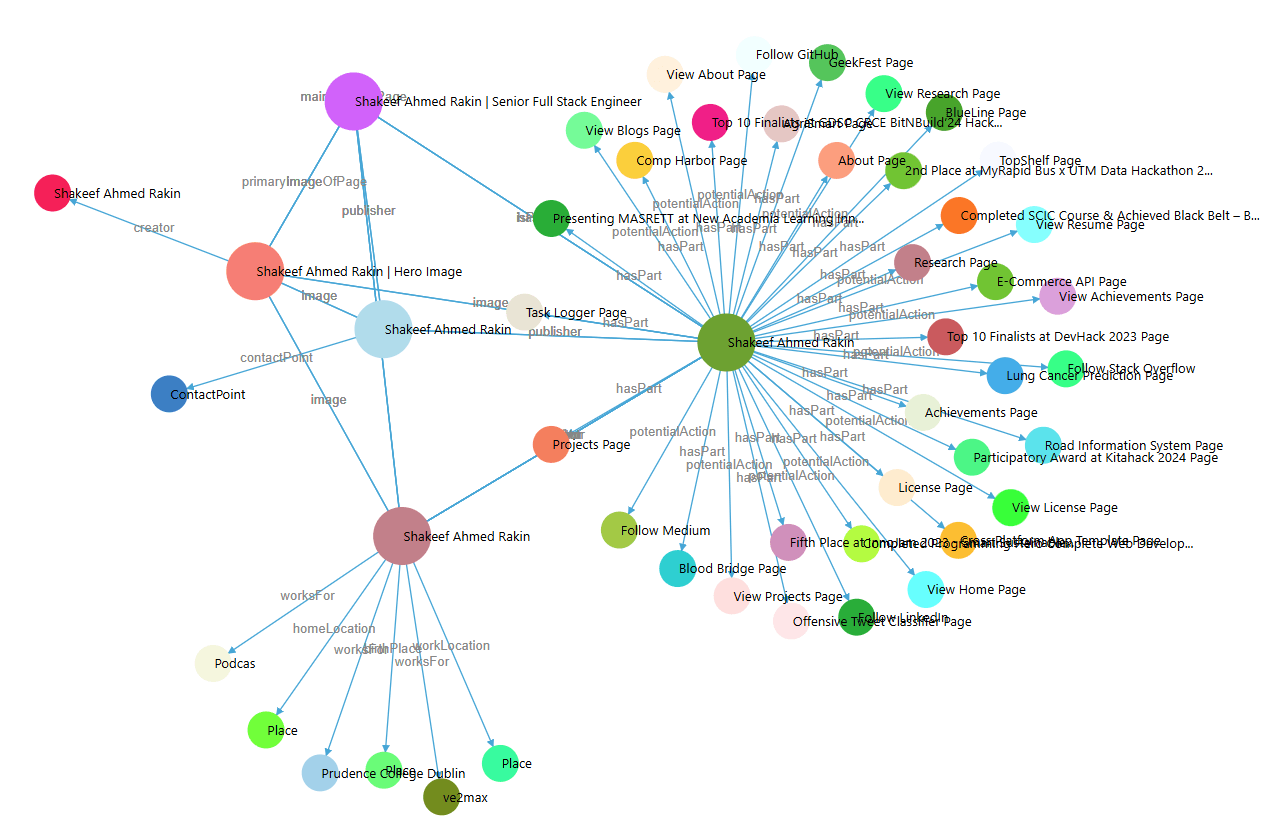
What that buys:
- Per-page-type schemas (
Person,Organization,Website,BreadcrumbList,TechArticle,BlogPosting,ImageObject) composed from shared primitives inmetadata/shared/. - Schema generators for projects, achievements, and research that derive structured data directly from MDX frontmatter and the compiled content.
- Type-safe schema authoring via
schema-dts, so a missing or wrong field is a compile error. - Automatic breadcrumb schema tied to the App Router segment structure.
- Dynamic sitemap and
robots.txtgeneration using Next.js conventions, keyed off the same Velite collections.
The result is that the site's structured-data graph is a side effect of the content, not a parallel artifact.
Dynamic Open Graph Images
A custom /api/og route on the Edge runtime produces page-specific OG images on demand. Each page passes a title and subtitle derived from the same MDX frontmatter or site-config.ts, and the generator composes the hero portrait, dotted-grid overlay, and embedded font into a single image response. No design tool round trip, no static OG dump committed to the repo, and no chance of an OG image drifting out of sync with the page it represents.
Styling and Animation as a System
Even the visual layer is built as a system rather than a per-page treatment:
- Tailwind CSS v4 with
@theme inlinedriven entirely from CSS custom properties inglobals.css. There is notailwind.config.ts. Theme tokens are the source of truth. - OKLCH color space across the entire palette, dark-mode only by design.
- Custom Spotlight component with dual Motion animations and configurable HSLA gradients.
- Intersection-observer driven scroll animations via
tailwindcss-intersect, with shared animation constants reused across sections so motion stays consistent without per-section tweaking. - Typography system,
cn()helper, CVA badge and button variants, and a small set of layout wrappers built in the shadcn/ui style.
Blog Integration
The home page surfaces my Medium articles through an RSS pipeline rather than a duplicated CMS. The Article type is defined locally and rendered through a dedicated blog grid, so my Medium publishing stays the canonical source and the portfolio reflects it without re-authoring.
Tech Stack
Why It Matters
The point of this project is not the surface design. The point is that the entire site is downstream of a small, typed, planned content and metadata graph. Once that graph is in place, the cost of adding or updating anything trends to zero. There is one place to change a project, one place to change a bio line, one place to add a paper, and the rest of the site, including its SEO and structured data layer, simply re-derives. That is the kind of system I tend to build at work, and the portfolio is the cleanest place to demonstrate it.